Why the BBP Economics Are Different
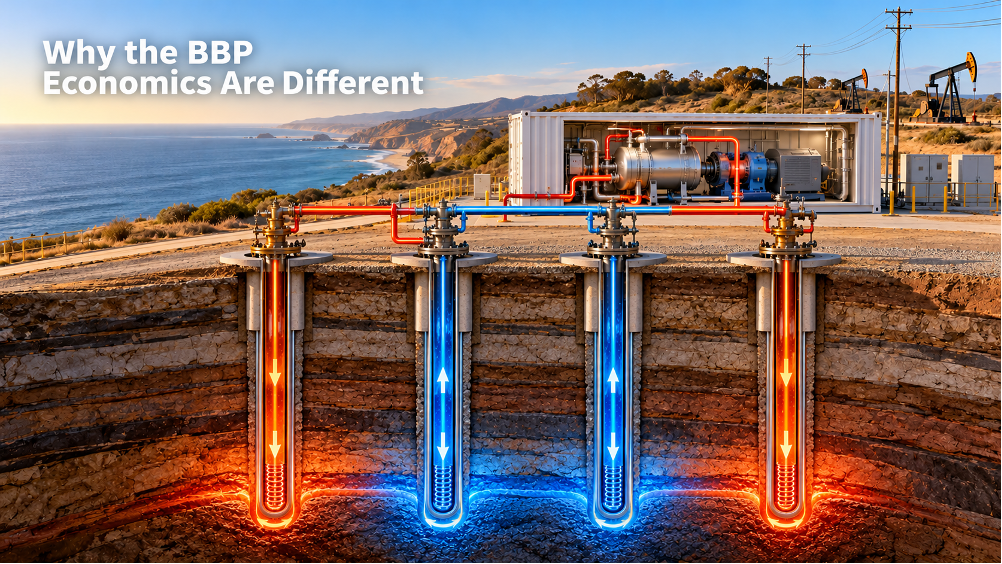
A conventional battery discussion usually begins with round-trip efficiency (RTE). Geo2Watts (G2W) begins with a fundamentally different question: what happens when the nation's existing oilfield infrastructure becomes the storage medium for dispatchable electricity, rather than a stranded asset awaiting permanent retirement? The Borehole Battery Platform™ (BBP) is designed to store electrical energy as heat in a closed loop using pressurized fresh water and repurposed idle wells, and later return that energy as dispatchable AC power.
Traditional battery discussions place considerable weight on RTE because new chemical-storage installations must recover the cost of manufactured cells, balance-of-plant equipment, and site development. BBP shifts the analysis toward capital efficiency and total system value. By reusing existing brownfield wellbores rather than constructing an entirely new underground storage asset, G2W seeks to avoid substantial portions of the land, civil-work, and infrastructure costs that would otherwise burden a greenfield project. These advantages must be established site by site, but their significance is clear: BBP is not simply storing energy - it is seeking to convert stranded industrial infrastructure into productive storage capacity.
The underlying physics is not speculative. High-temperature heat pumps, compressors, heat exchangers, thermal storage, expanders and synchronous generators are established industrial technologies. The innovation - and the engineering challenge - lies in integrating them into a reliable, manufacturable system. G2W is undertaking transient thermodynamic modeling, component matching, controls development, well-integrity analysis, and independent validation to determine actual efficiency, output, durability, and cost. Those results, rather than an assumed RTE target, will establish the bankable plant configuration.
The little-known 5 kWh rule - and why capital efficiency changes the calculus
Congress created a surprisingly low statutory threshold for qualifying electrical energy-storage technology. Section 48(c)(6)(A)(i), incorporated into section 48E(c)(2), covers property that receives, stores, and delivers energy for conversion to electricity and has a nameplate capacity of at least 5 kilowatt-hours (kWh). The final section 48E regulations, published in the Federal Register on January 15, 2025, adopted that same definition in Treasury Regulation section 1.48E-2(g)(6)(i).
The 5 kWh threshold is not a loophole. It is express statutory language retained in final Treasury regulations, and it is a capacity threshold, not a 5 kW power rating or a minimum RTE requirement. Treasury declined requests to impose a higher threshold inconsistent with the statute. A commercial BBP would be sized vastly above 5 kWh, but the point is that Congress established a technology-neutral doorway to eligibility for qualifying electricity-returning storage - not a preferential efficiency test for lithium-ion batteries.
This does not make a small storage installation financially viable or confer a credit automatically. It changes the comparison that investors are entitled to make. If BBP and lithium-ion storage both satisfy §48E, higher battery RTE alone does not determine which investment has the better economics. Capital deployed per usable megawatt-hour, qualified tax basis, site development, long-duration dispatch, parasitic loads, reliability, and valuable grid services must all be considered together.
Consider a hypothetical comparison: a new battery project may return a larger fraction of each purchased megawatt-hour, while BBP may require more charging electricity but less incremental capital for its storage medium because the wells already exist. If the avoided construction costs, lower after-credit capital investment, long-duration capability and GridValue™ revenues exceed BBP's additional energy losses and operating costs, BBP could produce a better risk-adjusted return. Both technologies face the same statutory 5 kWh entry threshold; neither receives an extra §48E rate merely for having higher RTE. This is an illustration of decision criteria, not a modeled claim of BBP superiority.
The regulations also distinguish electrical energy storage from a separate category of thermal storage intended to shift building heating and cooling loads. BBP uses heat as its intermediate storage medium but is designed to return stored energy as electricity. G2W therefore intends to qualify it under the electrical energy-storage definition, with system boundaries, capacity and classification confirmed in counsel's opinion.
Underwriting the 50% ITC - with defensible qualified basis
G2W's project selection rule is straightforward: only wells and configurations expected to satisfy all applicable §48E requirements enter the investment program. Its AI-based screening evaluates well integrity and geometry, location, energy-community status, proposed asset ownership, sourcing, construction timing, and the evidentiary support required for a tax opinion. The target 50% ITC is a fundamental underwriting premise for selected projects rather than speculative upside.
The targeted 50% credit combines the 30% enhanced rate, where applicable, with a 10-percentage-point energy-community increase and a 10-percentage-point domestic-content increase, each subject to its own statutory requirements. An idle oil well's location does not by itself establish energy-community qualification, and U.S. siting does not automatically satisfy domestic-content or Prohibited Foreign Entity (PFE) tests. G2W intends to verify these elements before committing capital.
A critical distinction is the qualified investment basis. Under Treasury Regulation §1.48E-2(g)(3) and (g)(4), the taxpayer generally must own property that is used directly in, and essential to, the energy-storage function, and the credit is measured by the basis of qualifying storage property placed in service by that taxpayer. G2W therefore proposes to document new well-liner systems, heat-transfer components, casing modifications, and other engineered elements as discrete capital improvements where those expenditures actually create qualifying, owned, and depreciable functional storage property. Engineering necessity, ownership, cost allocation, and placed-in-service documentation - not the accounting label alone - will govern eligibility.
OBBBA - domestic supply chains as a competitive moat
The One Big Beautiful Bill Act (OBBBA) preserved the §48E framework for qualifying energy storage while introducing PFE restrictions. IRS Notice 2026-15 provides interim guidance on the material-assistance cost ratio and safe harbors for certain projects beginning construction after 2025. As a result, component origin, investor rights, contractual control, and purchasing records may directly affect the credit's availability - not merely the project's procurement cost.
BBP's domestic footprint offers a strategic opening: existing U.S. wellbores, steel-intensive subsurface equipment, rotating generators and industrial machinery that can be sourced from compliant American manufacturers. This architecture would reduce exposure to foreign-dependent battery-cell supply chains, tariff volatility, and tax-credit recapture concerns. G2W must still verify actual domestic content and PFE compliance - a U.S. wellbore is not a blanket exemption - but procurement designed around OBBBA can become a defensible commercial advantage rather than a last-minute tax exercise.
Monetizing GridValue™ - the synchronous generation advantage
Conventional batteries store electricity electrochemically and ordinarily reach the AC grid through inverters. By contrast, BBP's proposed expander-driven synchronous generator can provide genuine rotating mechanical inertia, fault-current contribution, and controllable reactive power as inherent machine capabilities, alongside dispatchable energy. These functions could be especially valuable to industrial microgrids and balancing authorities concerned with stability, voltage support and the loss of synchronous resources. Advanced grid-forming inverters can also provide important fast-response grid services, so the distinction is not that batteries can never support the grid: it is that BBP may deliver a different physical service profile without depending on inverter emulation. Revenue for any of these attributes requires actual market products, operating agreements or contracted services; it must be modeled and verified rather than assumed.
First-mover advantage in an uncrowded category
G2W believes it is a first mover in the specific commercial strategy of converting idle, cased oil wells into high-temperature, electricity-returning thermal storage integrated with §48E qualification, domestic supply-chain planning and synchronous power generation. G2W has not identified a commercial-scale competitor pursuing that same complete architecture, and its prior-art review has not identified the same proposed configuration. Early pilot sites, engineering partners, operational data, and regulatory familiarity can compound that lead.
The central question is no longer whether the individual processes are scientifically possible. It is whether G2W can integrate them into a repeatable, independently validated product whose capital efficiency, after-tax cost, and measurable GridValue™ justify commercial deployment. The 5 kWh rule gives qualifying novel storage systems a clear statutory entry point. OBBBA supplies a reason to engineer compliant domestic supply chains. Brownfield reuse supplies a path to lower incremental infrastructure cost. Combined, those factors may allow the BBP to compete on what ultimately matters to customers and investors: reliable dispatchable power and superior total system value per dollar invested.
Legal footnotes and primary authorities
1. Internal Revenue Code, 26 U.S.C. section 48(c)(6)(A)(i) and 26 U.S.C. section 48E(c)(2). Section 48E adopts the section 48 energy-storage definition, including the requirement that qualifying electrical energy-storage property have a nameplate capacity of not less than 5 kilowatt-hours. https://uscode.house.gov/
2. Section 45Y Clean Electricity Production Credit and Section 48E Clean Electricity Investment Credit, T.D. 10024, 90 Fed. Reg. 4006 (Jan. 15, 2025). The final regulations added 26 C.F.R. sections 1.48E-1 through 1.48E-5 and confirmed the 5 kWh threshold for electrical energy-storage property. Treasury explained in the rulemaking that it would not impose higher thresholds inconsistent with the statute. https://www.federalregister.gov/documents/2025/01/15/2025-00196/
3. 26 C.F.R. §1.48E-2(g)(2)-(4), (6)(i)-(ii): functionally interdependent components; taxpayer ownership and integral property; qualified investment basis; electrical versus building thermal-storage categories. https://www.ecfr.gov/current/title-26/section-1.48E-2
4. Proposed rulemaking: REG-119283-23, 89 Fed. Reg. 47792 (June 3, 2024), later reflected in Internal Revenue Bulletin 2024-32. The rulemaking history helps show that Treasury considered public comments on energy-storage definitions before issuing the final regulations. https://www.federalregister.gov/documents/2024/06/03/2024-11719/
5. 26 U.S.C. §48E(a)(2)-(3), (d)(3)-(4): applicable rates, bonus increases, prevailing wages, and apprenticeship. Public Law 119-21 (July 4, 2025), OBBBA, enacted PFE-related restrictions; IRS Notice 2026-15 (IRB 2026-11) describes interim material-assistance safe harbors. https://www.congress.gov/119/plaws/publ21/PLAW-119publ21.pdf ; https://www.irs.gov/irb/2026-11_IRB