The New Currency of Artificial Intelligence
Copyright © 2026 Philip C. Cruver
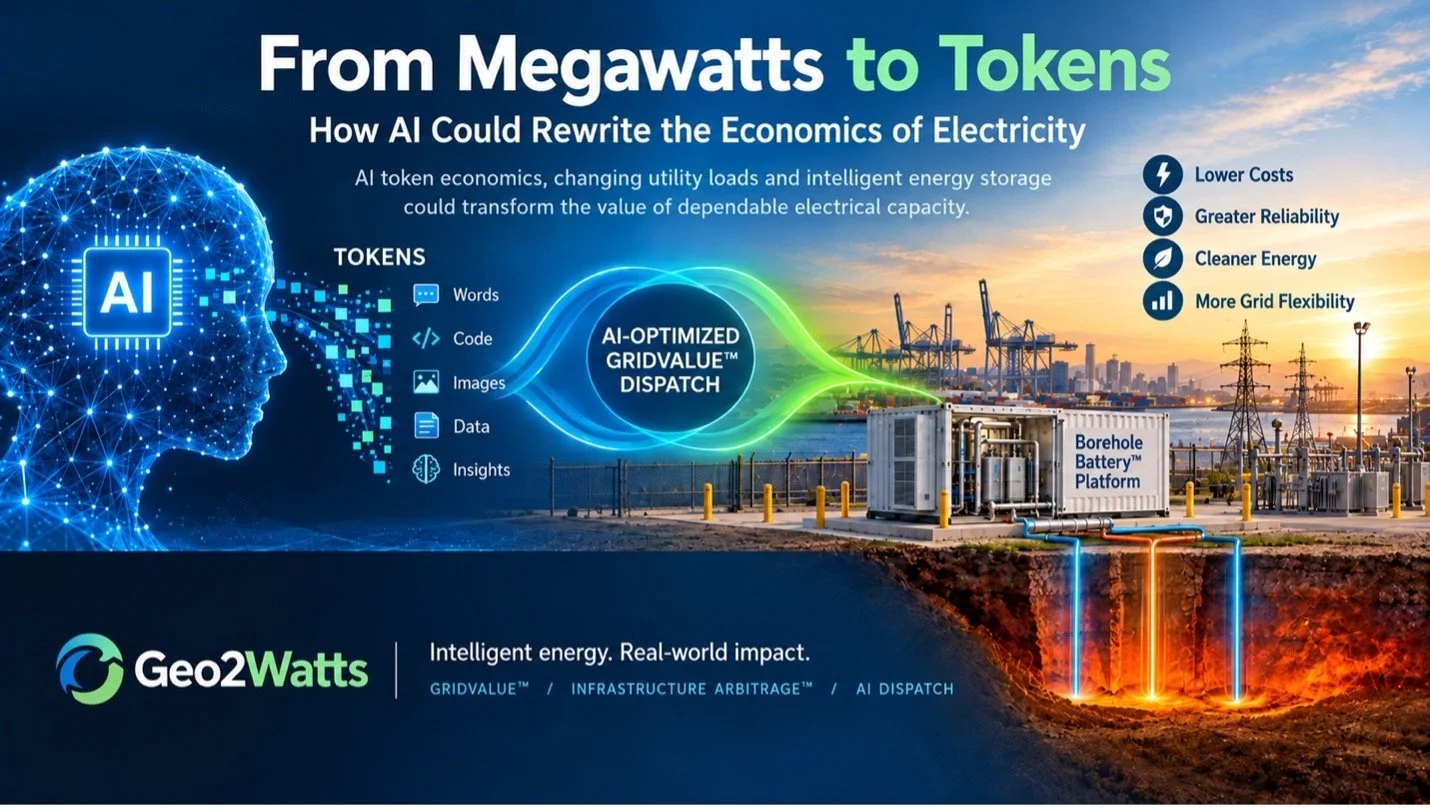
Most people using ChatGPT and other artificial intelligence applications have little understanding of the economic machinery behind their computer screens. AI processes information in small units called tokens, which represent words, portions of words, numbers, or symbols. As a rough approximation, 1,000 tokens represent about 750 English words. AI providers increasingly charge customers according to the tokens processed, much as electric utilities charge for kilowatt-hours consumed.
Tokens are not money, but they are becoming a commercial currency of the intelligence economy. NVIDIA now describes AI data centers as token factories, measuring productivity in tokens per second, tokens per watt, and cost per million tokens. Just as electricity investors compare the cost of producing megawatt-hours, AI investors increasingly evaluate the cost of producing useful intelligence.
The connection is profound because every token requires computing infrastructure powered by electricity. But the cheapest electricity does not necessarily produce the most valuable intelligence, just as the lowest-cost megawatt-hour does not necessarily provide the greatest value to the electrical grid.
Are Energy Investors Watching the Wrong Meter?
In our earlier Geo2Watts article, Are Renewable Energy Investors Watching the Wrong Meter?, we argued that traditional levelized cost of electricity (LCOE) calculations often overlook the value of dependable capacity available when and where electricity is needed. California illustrates this distinction with abundant low-cost solar generation during daylight hours and premium pricing for dependable capacity during periods of constrained supply.
AI introduces another dimension. Hyperscalers investing billions in computing equipment must consider not simply electricity prices, but the economic consequences of unavailable power, limited interconnection capacity, and reduced processor utilization. A megawatt of dependable electricity may enable far greater economic productivity than its commodity price suggests.
More importantly, AI is changing the operating characteristics of the grid itself. Unlike many traditional industrial facilities with relatively predictable loads, large AI computing clusters can experience rapid fluctuations as processors initiate, suspend, and resume computational workloads. NERC and national laboratory researchers have identified these changing load characteristics as emerging challenges for grid reliability, voltage stability, and resource planning. Utilities must therefore accommodate not only unprecedented load growth, but also new patterns of demand that may increase the value of flexible, dispatchable resources.
Token Economics Meets GridValue™
The electricity industry does not need to replace kilowatt-hours with tokens. Instead, it can adopt the economic discipline behind token-based computing: continuously measuring operational costs, evaluating alternatives, and optimizing productive value.
This principle aligns with Geo2Watts' GridValue™ framework, which recognizes that electricity's economic value depends upon its timing, location, reliability, and ability to support grid operations. AI could enable utilities and energy storage operators to evaluate thousands of operating scenarios, incorporating electricity tariffs, demand forecasts, renewable generation, transmission constraints, and equipment performance.
Imagine a utility serving several large AI computing facilities where electrical demand can increase sharply while solar generation is declining. An intelligent energy management system could forecast these conditions and coordinate available storage resources to reduce charging loads, increase electrical generation, or preserve capacity for periods of greater economic value. The objective would be to maximize the value of electrical capacity, rather than simply minimize the cost of electricity.
How Geo2Watts Could Apply AI to the Borehole Battery™
Geo2Watts is developing its Borehole Battery™ Platform (BBP) to repurpose suitable idle oil wells for long-duration thermal energy storage. Grid electricity powers industrial high-temperature heat-pump equipment that stores thermal energy underground, which can subsequently be recovered through an expander-generator system to deliver electricity.
The proposed reversible high-temperature heat pump (RHTHP) architecture could ultimately provide additional operating flexibility by coordinating charging and discharging functions. An AI-Optimized GridValue™ Dispatch system could evaluate real-time electricity tariffs, thermal storage conditions, equipment efficiency, and anticipated load requirements to determine the most economically advantageous operating strategy.
Consider a hypothetical 10 MW BBP installation supplying an industrial facility in Southern California. During periods of inexpensive solar electricity, AI could determine the optimal charging schedule based on electricity costs, thermal recovery efficiency, and expected future demand. During evening peaks, the system could discharge stored energy to reduce utility purchases or preserve capacity for a subsequent, more valuable period.
For illustration, delivering 100 MWh of electricity when avoided utility purchases are worth $100/MWh creates $10,000 in gross avoided purchases. Delivering that same electricity when its value reaches $200/MWh creates $20,000. The additional $10,000 comes not from generating more energy, but from delivering it when it is worth more, before accounting for charging costs and other expenses.
The RHTHP's potential responsiveness adds another dimension. During charging, reducing compressor power could rapidly lower demand on the grid. During discharge, an operating expander-generator might adjust output to accommodate changing loads, subject to validated machinery ramp rates and thermal constraints. These capabilities could complement faster-acting electrical resources while providing sustained power over longer periods. Actual response times and efficiency must be established through engineering and pilot validation.
Behind-the-Meter Infrastructure Arbitrage™
For Geo2Watts, the immediate opportunity may lie not in supplying hyperscalers directly, but in using intelligent storage to reduce electricity expenses for existing industrial customers while providing potential value to utilities.
At Long Beach's THUMS oil-producing islands, electricity supports continuous pumping operations essential to subsidence management. A BBP installation could potentially charge during economically favorable periods and discharge when avoided utility purchases have greater value, reducing operating expenses while maintaining necessary electrical service.
AI dispatch could optimize these decisions against actual retail tariffs, demand charges, thermal performance, and applicable grid-service contracts. Geo2Watts' Infrastructure Arbitrage™ concept adds the potential advantage of reusing existing industrial infrastructure rather than constructing entirely new facilities. Together, intelligent dispatch and infrastructure reuse could improve project economics without increasing installed generating capacity.
A New Calculus for Energy Investors
AI token economics is teaching the computing industry to distinguish between the cost of processing information and the value of useful intelligence produced. The electricity industry faces a parallel challenge: distinguishing between the cost of generating electricity and the value of dependable capacity delivered when and where it is needed.
As AI reshapes utility demand, Geo2Watts believes the convergence of GridValue™, Infrastructure Arbitrage™, and intelligent energy management offers a promising framework for evaluating long-duration storage. The BBP's strategic objective is straightforward: transform existing industrial infrastructure into intelligently managed electrical capacity capable of responding to an increasingly dynamic grid.
If AI is changing how the world measures the value of intelligence, perhaps it is time to change how we measure the value of electricity.
Related article: Are Renewable Energy Investors Watching the Wrong Meter?