Are Renewable Energy Investors Watching the Wrong Meter?
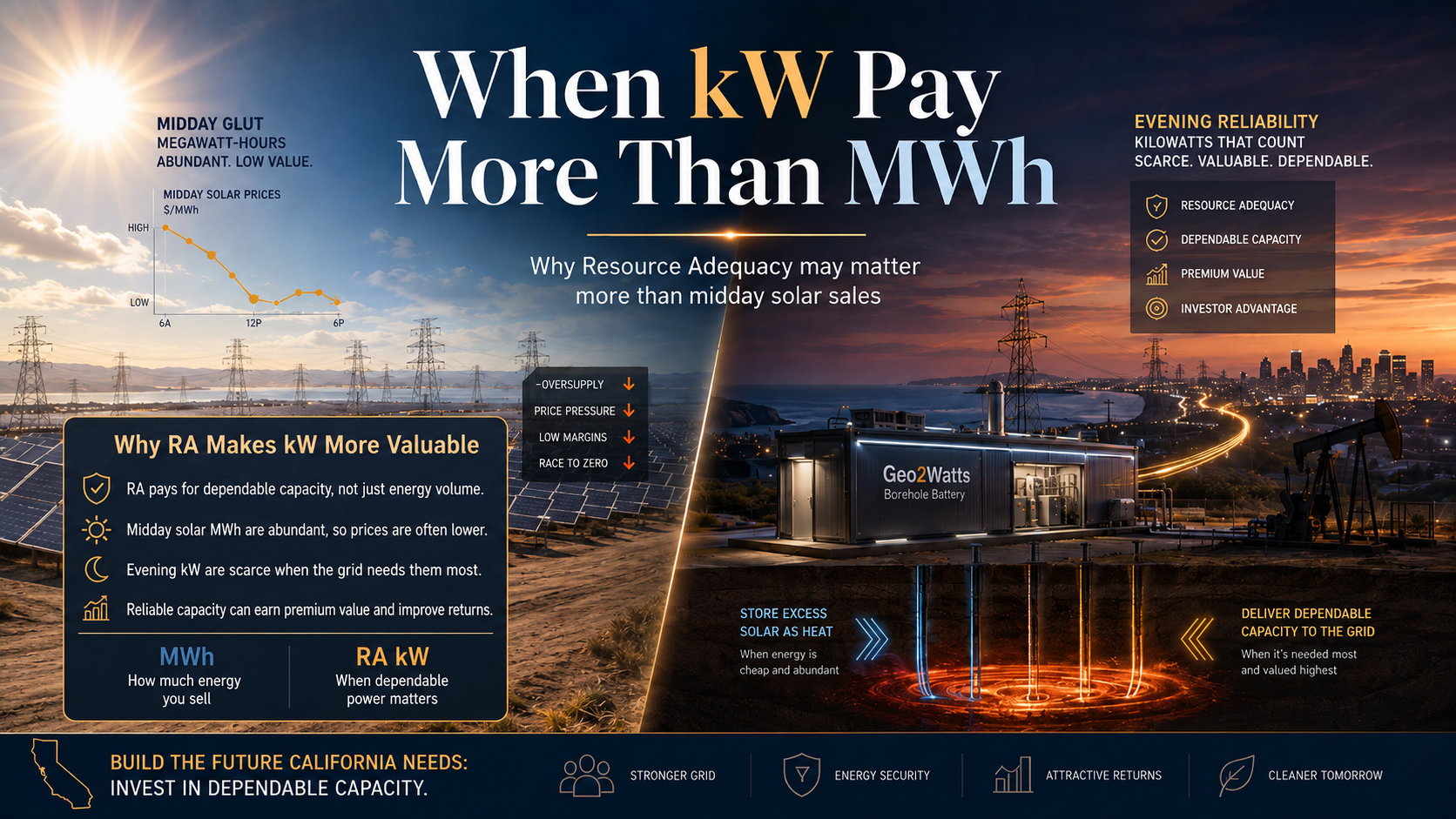
California doesn’t simply need more electrons. It increasingly needs electrons at the right time. That distinction could fundamentally change how investors evaluate long-duration energy storage. Welcome to the difference between MWh and kW, whereby a megawatt-hour measures energy. A kilowatt of Resource Adequacy (RA) measures something potentially more valuable: the dependable capacity available to keep California’s grid reliable when needed.
California‘s RA program requires load-serving entities to demonstrate that sufficient qualifying capacity is available to meet reliability requirements. Under the state’s Slice-of-Day framework, reliability is evaluated across the hours of the day rather than simply against an old-fashioned afternoon peak. Storage resources must demonstrate their ability to deliver energy while respecting charging, efficiency, and state-of-charge limitations.
This changes the investment question: instead of asking only, How many MWh can this project sell? " investors should also be asking: How many dependable kW can this asset sell when California actually needs them? Those are very different economic propositions.
Consider some illustrative arithmetic
The CPUC’s published 2025 compensation calculation showed a weighted-average System RA contract price of $25.19 per kW-month for contracts executed during 2024 for delivery during 2025 and 2026. Prices varied materially by location, including higher values in several constrained local areas. That historical benchmark is not a forecast or guaranteed future price. RA is generally contracted bilaterally, and value varies by location, resource characteristics, and market conditions. But it demonstrates the magnitude of the opportunity. At $25.19/kW-month, 10 MW of qualifying capacity would represent approximately: 10,000 kW × $25.19 × 12 = $3.02 million per year in capacity revenue. And that is before considering potential energy sales, charging economics, ancillary services, flexibility, local capacity value, or other revenue streams.
This reveals a potentially transformative investment proposition: a 10 MW energy storage project that qualifies for RA could generate approximately $3 million annually simply by maintaining dependable, dispatchable capacity - without having to sell a single megawatt-hour of electricity. In a strategically critical location where grid reliability and local capacity are especially valuable, that recurring revenue could potentially cover operating costs, financing obligations, and provide an attractive investor return before energy sales are considered. For investors, the distinction is fundamental: the project is being compensated for its ability to deliver electricity when needed, not for how often it actually generates electricity.
As an example, consider the THUMS offshore oil islands in Long Beach, California, where reliable electricity is essential to operating the water-injection pumps that prevent subsidence. That recurring capacity revenue could help make the project economical even with minimal electricity generation. More importantly, its ability to protect critical infrastructure against power interruptions creates additional value that conventional electricity pricing fails to capture. At THUMS, the most valuable megawatt may be the one that never needs to be generated.
Now compare that conceptually with a merchant renewable generator whose economics depend primarily on selling MWh precisely when thousands of neighboring generators are producing the same commodity. CAISO reported that average 2025 day-ahead electricity prices were about $39/MWh, with abundant renewable generation contributing to lower prices during solar-production hours in parts of California. This is Economics 101: If everybody arrives at the farmers market at noon carrying tomatoes, noon may not be the best time to be in the tomato business. Solar remains essential. The issue is not whether California needs more renewable generation. It is whether the next investment dollar earns a better return producing another midday MWh or transforming abundant low-value electricity into dependable capacity that can be delivered later.
The new renewable commodity is time, and storage does something generation alone cannot. It separates when electricity is produced from when electricity is consumed, and long-duration energy storage (LDES) extends that capability beyond the familiar four-hour battery window. This becomes increasingly important as California adds more solar and batteries. The CPUC itself has recognized that increasing storage penetration creates questions about declining marginal capacity contributions from conventional storage and about how the market should distinguish resources capable of delivering for longer durations.
California isn’t hiding the demand signal either. In February 2026, the CPUC ordered electricity providers under its jurisdiction to procure 6,000 MW of new clean-energy and storage Net Qualifying Capacity (NQC) for 2029–2032. Notice the unit - not 6,000 MWh - 6,000 MW of qualifying capacity. There is an important message buried in that terminology for investors. California is sending investors a powerful message: the next energy gold rush may not be about how many megawatt-hours (MWh) a project generates, but how many dependable megawatts (MW) it can deliver when the grid needs them most - and those megawatts can earn millions even while standing idle.
GridValue™ and Infrastructure Arbitrage.
Levelized cost and round-trip efficiency matter, but they do not capture the entire value of an asset that can absorb inexpensive electricity, store energy for long periods, and return dispatchable power when the grid needs it. The more useful question is: What is each kilowatt of dependable capacity worth to the grid? The Borehole Battery™ Platform (BBP) is being developed around this principle. Rather than competing with solar, it is intended to complement it by accepting electricity when renewable production is abundant and returning power when its GridValue™ is higher. And rather than building every component of an energy project from scratch, the BBP is being designed for brownfield locations where existing industrial infrastructure, including idle oil wells, substations, electrical connections, and large loads, may be repurposed for LDES.
This creates another form of arbitrage investors sometimes overlook, namely infrastructure arbitrage, which is the value created by reusing infrastructure that has already been paid for, permitted, interconnected, and proven in operation rather than rebuilding those assets from scratch. For energy investors, that can be just as important as energy-price arbitrage. A brownfield site with an existing substation, transformers, transmission access, roads, industrial loads, water systems, and permitted well infrastructure may avoid years of development time and millions of dollars in new capital expense. The cheapest substation may be the one already built, the fastest interconnection may be the one already operating, and the least risky project may be the one that starts with infrastructure regulators and communities already understand. When storage is added to that existing platform, investors can capture both forms of arbitrage at once: infrastructure arbitrage on the way in and energy-value arbitrage on the way out. The result is a project that can potentially reach operation faster, require less greenfield capital, face fewer interconnection hurdles, and sell electricity when it is most valuable rather than when everyone else is producing it.
From Energy Volume to Capacity Value
The first generation of renewable investing was largely about producing the lowest-cost MWh. The next generation may be about delivering the highest-value kW. California’s increasingly solar-rich grid is making energy abundant during certain hours while simultaneously placing a premium on dependable, dispatchable capacity during others. That creates an opportunity for investors willing to look beyond yesterday’s metrics, so before racing after another project because everyone else seems to be racing after it, perhaps investment committees should ask three questions: 1) What will our electricity be worth when we produce it? 2) How much RA can our asset reliably provide? 3) Are we investing around the grid California is rapidly becoming? Because in the emerging electricity market, producing renewable energy is only half the business. Being available when everybody needs it may be where the real money is.