Borehole Battery Platform
The economics of long-duration energy storage (LDES) are entering a new era in which the lowest-cost electron is not necessarily the most valuable. As America's electricity grid confronts surging demand, aging infrastructure, and growing challenges facing battery energy storage systems (BESS), Geo2Watts (G2W) is developing a novel alternative that transforms idle oil wells into productive energy-storage assets.
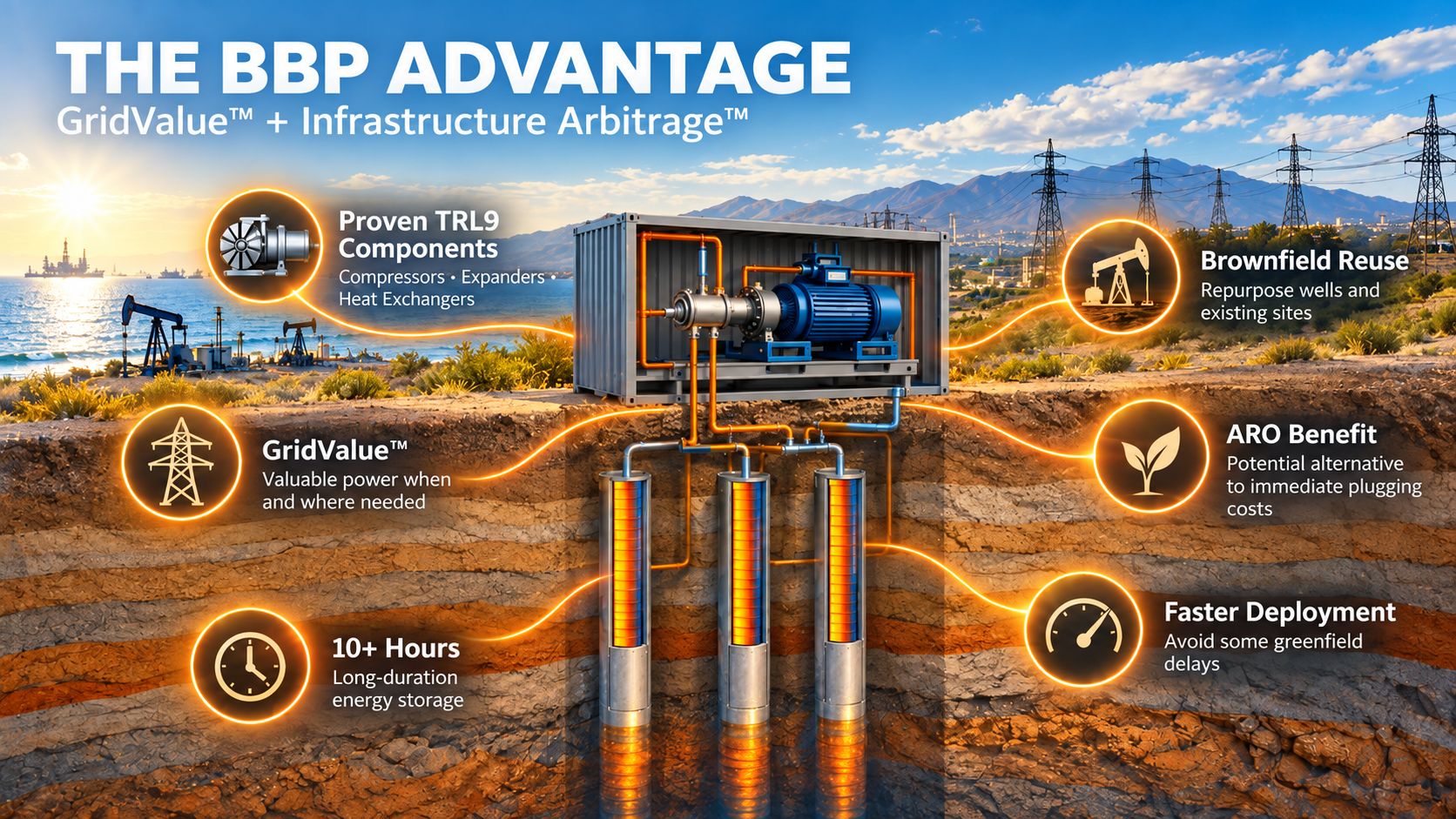
The Borehole Battery Platform™ (BBP) integrates commercially proven TRL9 components, including compressors, expanders, heat exchangers, and generators, with underground thermal energy storage. Rather than inventing new machinery, G2W is integrating existing technologies into a novel system for validating round-trip efficiency (RTE), heat-pump coefficient of performance (COP), and levelized cost of storage (LCOS). Although initial RTE may not be as high as BESS, thermodynamic efficiency alone does not determine economic competitiveness.
G2W's competitive advantage is built around two concepts: GridValue™ and Infrastructure Arbitrage™. GridValue™ recognizes that dispatchable electricity delivered when and where it is needed can be worth more than the lowest-cost electron. Infrastructure Arbitrage™ captures the economic advantages of repurposing existing wells, industrial sites, and electrical infrastructure, potentially reducing capital costs and accelerating deployment by avoiding some of the lengthy permitting, transformer procurement, and grid-interconnection delays confronting new energy projects.
The comparison with BESS becomes more compelling when considering lithium-related supply-chain dependencies, foreign-entity restrictions, and potential tax-credit recapture, battery degradation, replacement costs, and fire-safety concerns. The BBP also avoids battery-style DC-to-AC inverters, eliminating their associated conversion losses while potentially providing valuable synchronous grid-support services.
Importantly, G2W expects successive engineering iterations, economies of scale, improved turbomachinery, and AI-driven optimization of charging and discharging to progressively improve both efficiency and economics. As the platform matures, the competitive gap with established storage technologies could narrow further.
The BBP does not need to produce the cheapest electron to become economically competitive. By combining GridValue™, Infrastructure Arbitrage™, faster deployment, and the potential to transform costly well-retirement obligations into productive assets, G2W seeks to deliver the most valuable electricity when and where America's evolving grid needs it.