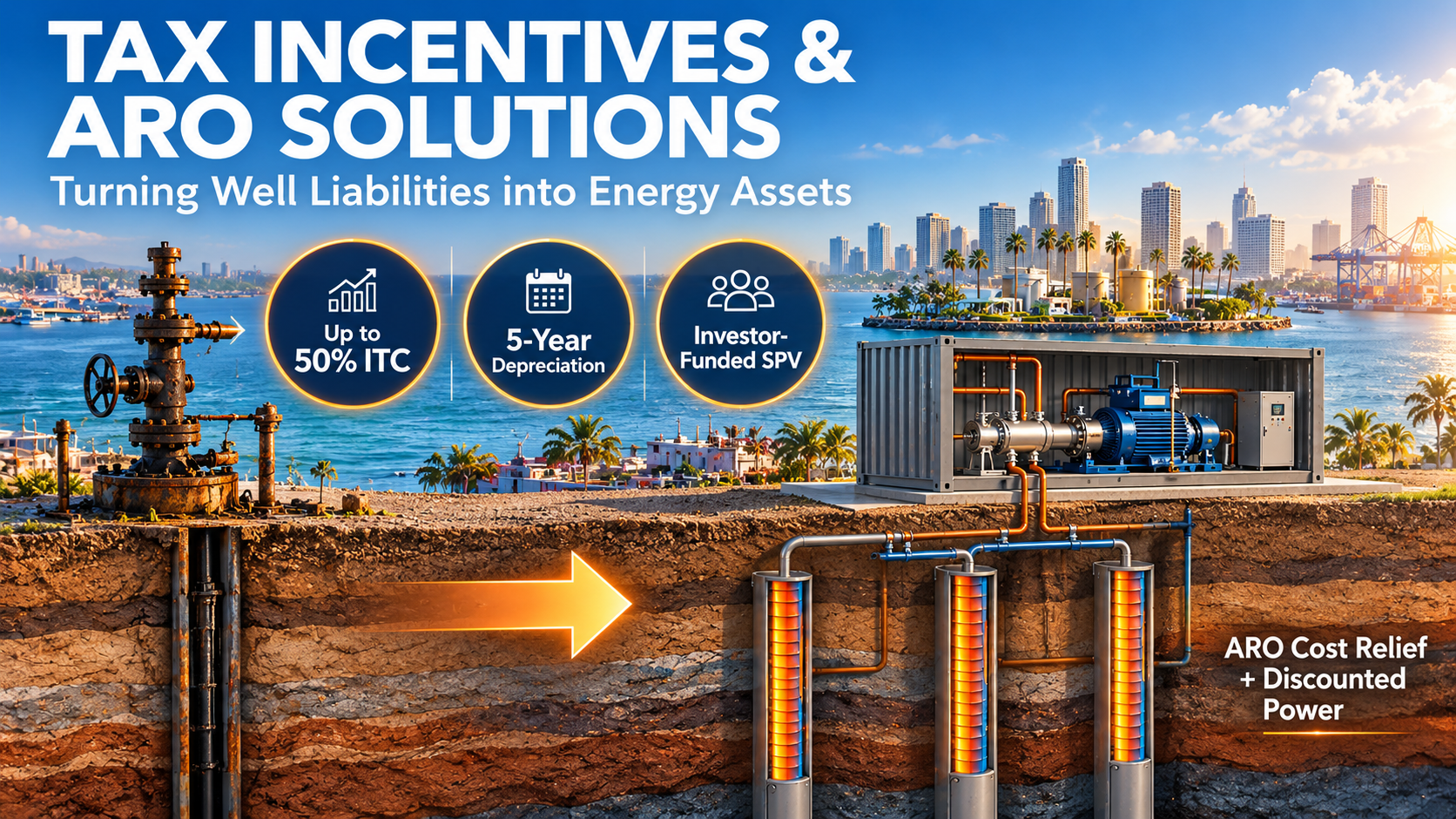
The One Big Beautiful Bill Act (OBBBA) has strengthened the investment opportunity for Geo2Watts (G2W) by preserving substantial federal tax incentives for qualifying energy storage technologies. Combined with California's increasingly stringent oil and gas regulations, these incentives create an opportunity to transform idle wells from costly Asset Retirement Obligations (AROs) into productive long-duration energy storage infrastructure.
Under Section 48E, qualifying Borehole Battery Platform™ (BBP) investments may receive a 50% Investment Tax Credit (ITC), reflecting the 30% qualifying credit plus domestic-content and energy-community bonuses of 10 percentage points each. Investors may also benefit from five-year accelerated depreciation on qualifying property, subject to applicable basis adjustments. Together, these incentives can substantially reduce the after-tax cost of deploying BBP installations.
A particularly important opportunity involves integrating oil well plugging and repurposing into the construction of the BBP itself. When plugging, wellbore modifications, casing protection, thermal components, and closed-loop heat exchangers are functionally necessary to create qualifying energy storage property, G2W intends to establish the basis for including eligible integrated construction expenditures in the Section 48E investment. This approach could extend the economic advantages of the ITC beyond aboveground equipment to qualifying underground infrastructure, potentially helping offset a substantial portion of well-retirement expenditures. The eligibility of individual costs will require documented engineering, tax, and regulatory analysis.
For oil and gas well owners, the potential benefits are compelling. California's SB 1137 establishes 3,200-foot health protection zones around sensitive locations, restricting oil and gas development and imposing additional requirements on existing facilities. Together with AB 1866's accelerated idle-well elimination requirements and escalating fees, these regulations increase the economic pressure to address aging well inventories. Rather than treating every retiring well solely as an abandonment expense, owners could explore converting suitable wells into long-lived energy assets while satisfying applicable regulatory obligations.
Under G2W’s proposed structure, oil and gas well owners retain ownership of their wells and pay the costs of plugging them in compliance with regulatory requirements. By engineering the plugging process as an integral component of the BBP, G2W seeks to qualify these expenditures for the 50% Section 48E Investment Tax Credit (ITC), potentially reducing the well owners’ net plugging costs by half, subject to IRS eligibility and tax-benefit allocation requirements. G2W investors would finance the BBP equipment and energy-storage infrastructure through a Special Purpose Vehicle (SPV), securing approximately 20 years of access to the repurposed wells. In addition to potential plugging-cost savings, well owners would benefit from approximately 20 years of discounted electricity, transforming a costly Asset Retirement Obligation (ARO) into a long-term economic opportunity while preserving well ownership.
The economic proposition combines federal investment incentives, accelerated depreciation, reduced exposure to well-retirement costs, and long-term electricity revenues. With California's regulatory deadlines accelerating the need for action, G2W offers oil and gas well owners and infrastructure investors an opportunity to collaborate on a new approach to energy storage.
Instead of spending capital solely to retire yesterday's oil wells, the BBP seeks to redirect eligible investment into tomorrow's energy infrastructure - turning costly liabilities into assets capable of generating long-term economic value.