Premium Pricing and Rapid Commercial Scaling Are Just As Important As Thermodynamic Efficiency when Evaluating Overall Economics
Copyright © 2026 Philip C. Cruver
When evaluating energy storage technologies, there is a natural tendency to focus on thermodynamic efficiency, round-trip efficiency (RTE), coefficient of performance (COP), and other engineering metrics. While these are important, they are not the primary drivers of real-world project economics.
In practice, the financial success of an energy storage system depends just as much, if not more, on how and when the energy is sold, where the resource is located, how the asset is valued by the grid, and how quickly it can be deployed at scale. Resources that are both distributed and dispatchable can provide additional value by delivering dependable power close to the loads and grid infrastructure that need it.
1) Premium Pricing Drives Value More Than Marginal Efficiency Gains
Electricity is not a commodity with a fixed price; it is a time and location-dependent product. This makes location an important economic attribute. A distributed resource located near industrial demand, constrained substations, or critical infrastructure may provide value that cannot be captured by comparing energy efficiency or systemwide wholesale prices alone. In California, wholesale electricity prices can vary dramatically throughout the day. Excess renewable generation during midday often drives prices down, while evening demand, particularly between 6 PM and 9 PM, creates sharp price spikes. This dynamic creates a consistent arbitrage opportunity.
Even with a lower RTE than some competing technologies, the ability to consistently capture high-value peakpricing can result in superior revenue performance. This highlights a critical point: A system that earns higher revenue per kilowatt-hour is often more valuable than one that simply conserves more energy.
2) Capacity Value Matters: ELCC and NQC Define Real Economics
At the utility level, economics are not driven solely by energy arbitrage, they are heavily influenced by how a resource contributes to grid reliability.
In California’s Resource Adequacy framework, the key metric is not installed megawatts, but Net Qualifying Capacity (NQC), which is the amount of capacity a resource can reliably provide to the grid. For intermittent and energy-limited resources, this value is further adjusted using Effective Load Carrying Capability (ELCC), which determines how much of a resource’s nameplate capacity counts toward reliability needs.
This distinction is crucial because a system with high thermodynamic efficiency but limited availability during peak demand periods may receive reduced capacity credit, while a system with slightly lower efficiency but strong dispatchability during critical hours can earn higher NQC and ELCC accreditation and therefore greater economic value.
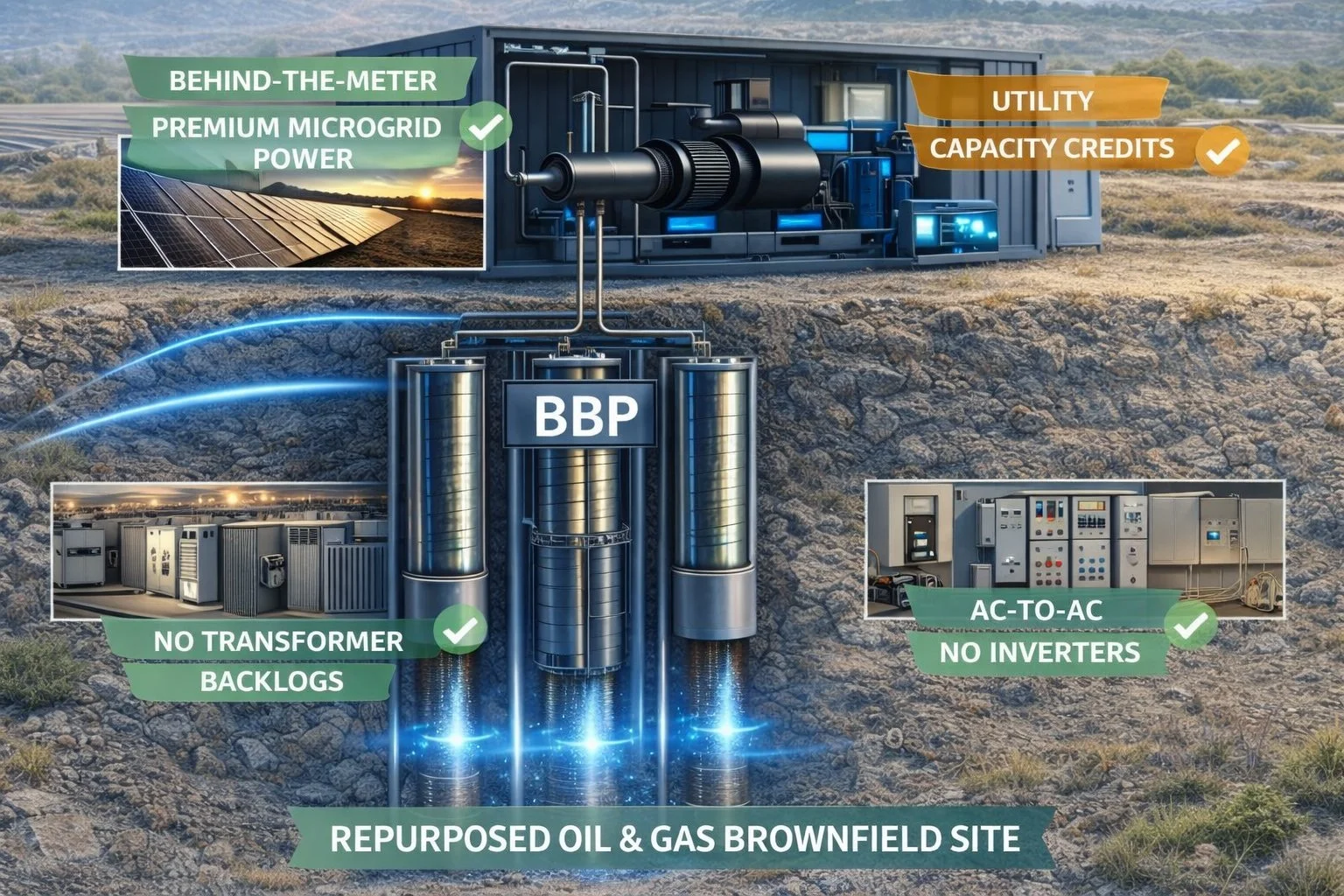
The Borehole Battery™ Platform (BBP) is designed to deliver long-duration, dispatchable output aligned with peak demand. When deployed at distributed brownfield locations near existing loads and electrical infrastructure, it may also provide localized reliability and infrastructure value. In this context, efficiency alone is not the right benchmark; dependable capacity delivered when and where it is needed is what creates economic value.
3) Policy Signals Reinforce the Value of Dispatchable Clean Capacity
The importance of capacity value is being reinforced by California policy. Recent CPUC actions require load-serving entities to procure 6,000 MW of new clean energy and storage capacity (measured in NQC) for the 2030–2032 timeframe. Importantly, at least 25% of this procurement must come from resources with clean-firm and/or long-duration storage attributes. This is a clear signal that the market is prioritizing reliable, dispatchable, clean capacity, not just low-cost energy or high-efficiency systems.
In parallel, legislation such as AB 1373 and related procurement frameworks are creating pathways for centralized acquisition of long lead-time, reliability-critical resources. These initiatives emphasize the need for technologies that can:
Deliver dependable capacity
Meet firm reliability requirements
Scale quickly enough to align with procurement timelines
4) Distributed Brownfield Deployment Enables Rapid Commercial Scaling
Equally important to pricing and capacity value is the ability to deploy quickly and at scale. One of the most significant advantages of the BBP is its ability to leverage existing oil and gas infrastructure. By utilizing idle wells and existing grid interconnections, the system avoids many of the bottlenecks associated with greenfield development, including:
Lengthy permitting timelines
Interconnection delays
Transformer and substation constraints
High upfront site development costs
This distributed brownfield model can enable projects to be developed incrementally, located close to demand, and aggregated across multiple well sites as deployment expands. It may also shorten development schedules by reducing exposure to greenfield permitting, interconnection, transmission, transformer, and site-development constraints. In a market requiring substantial additions of dependable clean capacity, speed and location are not merely conveniences; they are competitive advantages. Technologies that can rapidly convert existing assets into accredited, dispatchable capacity are inherently more valuable than those that require long development cycles, even if the latter appear more efficient on paper.
5) A Broader Definition of Performance
The BBP challenges the conventional way energy storage technologies are evaluated. Rather than optimizing solely for thermodynamic efficiency, it is designed to optimize for total economic performance, which includes:
Capturing premium electricity pricing
Maximizing ELCC and NQC capacity value
Aligning with California’s clean capacity procurement mandates
Enabling rapid deployment through brownfield infrastructure
This broader framework reflects how energy systems are valued in modern electricity markets. Thermodynamic efficiency remains an important metric, but it is not the defining factor in determining economic success. In today’s energy landscape, electricity pricing, accredited capacity value, policy alignment, and speed of deployment are equally, if not more important.
The BBP succeeds not merely because of how it stores energy, but because of how effectively it:
Monetizes premium peak pricing
Qualifies for dependable capacity value under ELCC and NQC frameworks
Aligns with emerging California procurement requirements such as AB 1373 and CPUC capacity mandates
Scales rapidly using existing brownfield infrastructure
Ultimately, the most valuable energy storage systems are not those that are the most efficient in theory, but those that are the most profitable, reliable, and deployable in practice.