Borehole Battery™ Platform 101 Explainer
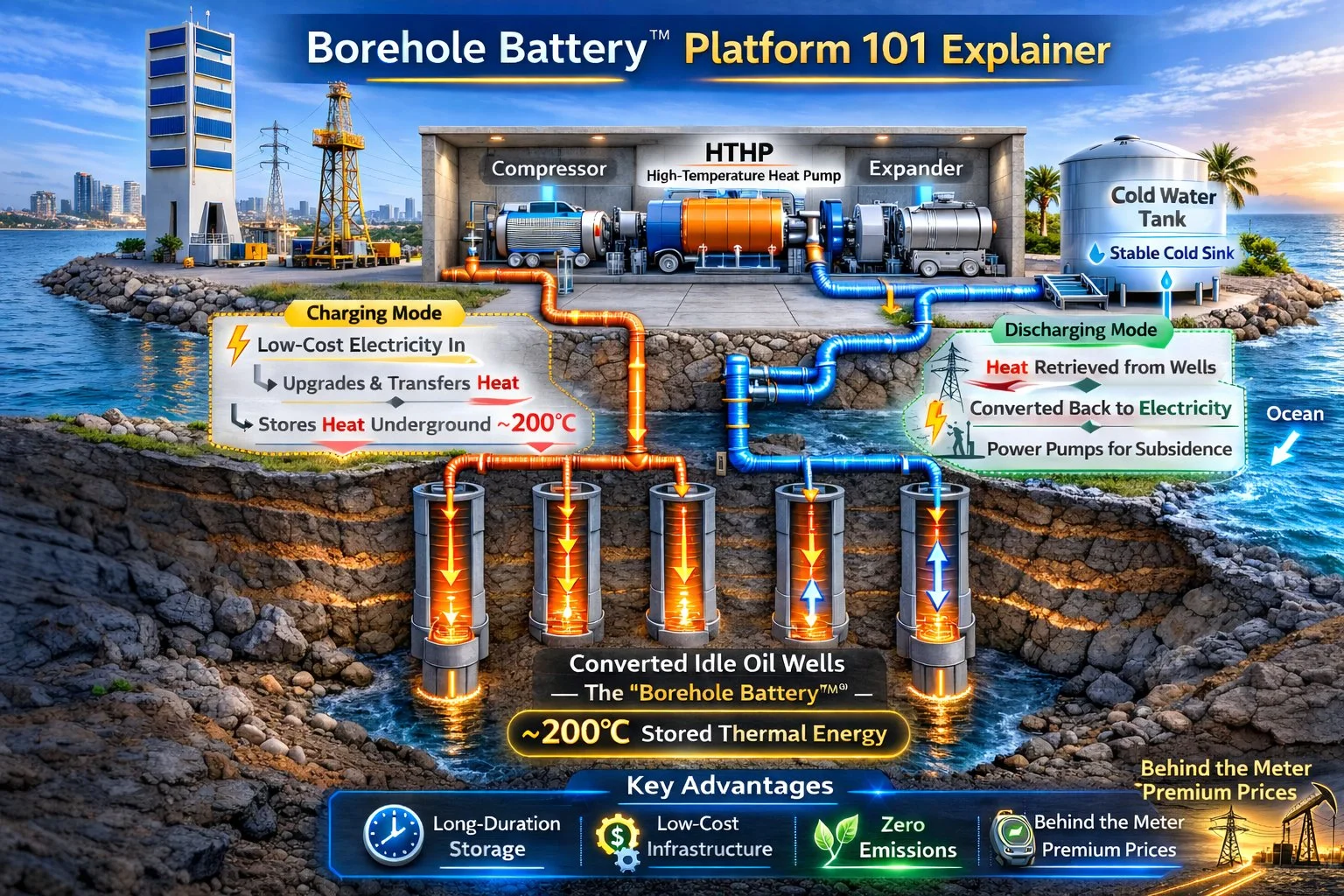
Understanding the Thermodynamics Behind the Borehole Battery™ Platform
The Borehole Battery™ Platform (BBP) is grounded in well-established physics. There is no exotic science involved only careful application of thermodynamics, that those not skilled in the science have difficulty understanding so here is Explainer 101.
At its core, the BBP uses a high-temperature heat pump (HTHP) to store electricity as heat underground, and later convert that stored heat back into electricity when it is needed. To understand how this works, it helps to clarify a few key concepts.
1. Coefficient of Performance (COP): Moving Heat vs. Creating Heat
A common misunderstanding arises when people hear that a heat pump can deliver more heat energy than the electrical energy it consumes.
For example, a heat pump can use 1 kilowatt (kW) of electricity to move 3 kilowatts (kW) of thermal energy. This appears to violate the laws of physics, but It doesn’t. A heat pump does not create energy; it moves existing heat from one place to another. The electricity powers the compressor, which enables the transfer of heat. Because it is relocating heat rather than generating it directly (like a resistance heater would), the system can deliver multiple units of heat for each unit of electricity consumed.
This ratio is called the Coefficient of Performance (COP) whereby a COP of 3 means:1 kW of electricity moves 3 kW of heat. This is fully consistent with thermodynamics and bounded by Carnot efficiency, which defines the theoretical maximum efficiency possible between two temperatures. There is no violation of physics but often a common misunderstanding.
2. Lift: The Temperature Difference That Matters
Another important concept is thermal lift that refers to the temperature difference between: The hot side (where heat is delivered), and the cold side (where heat is absorbed). The larger the temperature difference, the harder the system must work.
In the BBP the hot side approaches ~200°C and the cold side is stabilized using the ocean and a controlled water tank. Because these temperature levels are stable and engineered within commercial operating ranges, achieving a COP in the 2–4 range is consistent with existing industrial high-temperature heat pump systems. The BBP operates within established engineering limits and not theoretical extremes.
3. Round-Trip Efficiency (RTE): Converting Back to Electricity
While COP measures how efficiently electricity is converted into stored heat RTE measures how much electricity you get back after the full cycle whereby electricity is stored as heat and later converted back to electricity. No energy storage system is 100% efficient. Batteries lose some energy to internal resistance. Mechanical systems lose energy to friction. Thermal systems lose energy due to temperature differences.
The BBP’s RTE reflects:
Heat pump charging efficiency
Thermal storage losses (which are minimal underground)
Power generation efficiency during discharge
This is expected and entirely consistent with thermodynamics and importantly, the BBP generates AC power directly, avoiding inverter losses common in battery energy storage systems (BESS).
4. PTES (Pumped Thermal Energy Storage): The “Carnot Battery” Concept
The BBP is based on a category of storage known as PTES that is sometimes called a “Carnot Battery.”
The idea simply uses electricity to create a temperature difference (store heat) and later use that temperature difference to generate electricity. This concept has been studied for decades. What is new is not the thermodynamics but the the infrastructure strategy application.
5. What Makes the BBP Novel
The BBP applies PTES principles in a new way. Instead of building massive, insulated tanks and dedicated storage facilities, it uses end-of-life idle oil and gas wells as underground thermal storage.
These wells already exist, are permitted and regulated, provide deep, thermally stable environments, and can circulate pressurized water (~200°C) in a closed loop. Rather than constructing purpose-built storage containers for greenfield projects, the BBP repurposes existing infrastructure for behind-the-meter brownfield projects for premium priced electricity.
The system:
Uses low-cost electricity to run the heat pump in compressor mode
Stores high-temperature thermal energy underground
Reverses operation to generate electricity during peak demand
No energy is created; it is time-shifted.
6. Why This Matters for Long-Duration Energy Storage (LDES)
Grid-scale energy storage must:
Absorb excess renewable electricity when it is cheap
Deliver electricity when it is scarce and expensive
Operate reliably for long durations
The BBP combines:
Proven heat pump engineering
Carnot-limited thermodynamics
Underground thermal stability
Distributed behind-the-meter deployment
This makes it:
Dispatchable
Scalable
Infrastructure-efficient
Compatible with existing interconnections
The novelty lies not in new physics but in combining COP, Lift management, RTE optimization, and PTES architecture into a distributed platform that leverages legacy energy infrastructure for LDES. The BBP is thermodynamics applied intelligently.